Whether a claw machine is a lawful amusement device or an illegal gambling machine is the single compliance question that decides if your route keeps running or your cabinets get seized. Get it wrong, and you face equipment confiscation, fines, and in some regions criminal exposure.
This guide benchmarks claw machine legality against the way regulators actually classify these devices: the skill-versus-chance test, prize value limits, machine configuration, and the licensing and placement rules commercial operators must satisfy. Legality turns on local statutes that differ widely between states and countries, so treat every figure here as an illustrative example and confirm the current rules with your local licensing authority or counsel before you install. For related setup steps, see our breakdown of how to start an arcade business.
Are Claw Machines Legal?

Claw machines are generally legal amusement devices when victory relies on player skill and prizes stay low-value, but probability-controlled mechanics can push them under strict local gambling laws.
The answer is not a simple yes or no. Regulators do not judge the machine by its name; they judge it by how it behaves in play. A cabinet that gives a coordinated player a genuine chance to win every time is treated as amusement. The same cabinet, reprogrammed to only pay out after a fixed coin count, is treated as a gaming machine.
The Core Legal Test: Game of Skill vs Gambling Device
Most authorities reduce the question to one factor: does physical coordination or random chance control the outcome? When a player relies on manual dexterity, timing, and spatial judgment to grab a prize, courts in many jurisdictions view the machine as an amusement device. Many regions carve out exemptions that protect operators precisely on this basis, provided the reward remains low-value and non-cash.
The machine enters gambling territory when chance overrides player capability. If a player pays to play and pre-programmed logic decides when the win happens, the setup can meet the legal definition of gambling, which usually has three elements: consideration (the fee), chance, and a prize. Remove or limit the “chance” element through consistent mechanical play, and the device more reliably stays on the amusement side of the line.
In practice this is why enforcement so often turns on the control board. Officers can play a machine a handful of times or pull the settings, and judge whether a skilled player could win on demand. An operator who can point to fixed grip strength and honest, skill-driven play has a far easier time defending the amusement classification than one running a machine whose win rate was tuned to a spreadsheet.
Technical Design Elements That Decide Legal Status
How you configure the hardware dictates its legal status. Investigators commonly inspect the control board and settings to check for rigged play. Three design factors carry the most weight:
- Grip consistency: The claw should hold the same mechanical grip strength on every play, giving a skilled player a genuine chance to win each time.
- Joystick control: The player should get direct, responsive horizontal and vertical movement over the whole prize field, so placement skill matters.
- Compensation logic: Settings that deliberately weaken the grip to hit a target payout rate are the feature most likely to reclassify a machine as gambling.
When Does a Claw Machine Cross Into Gambling?
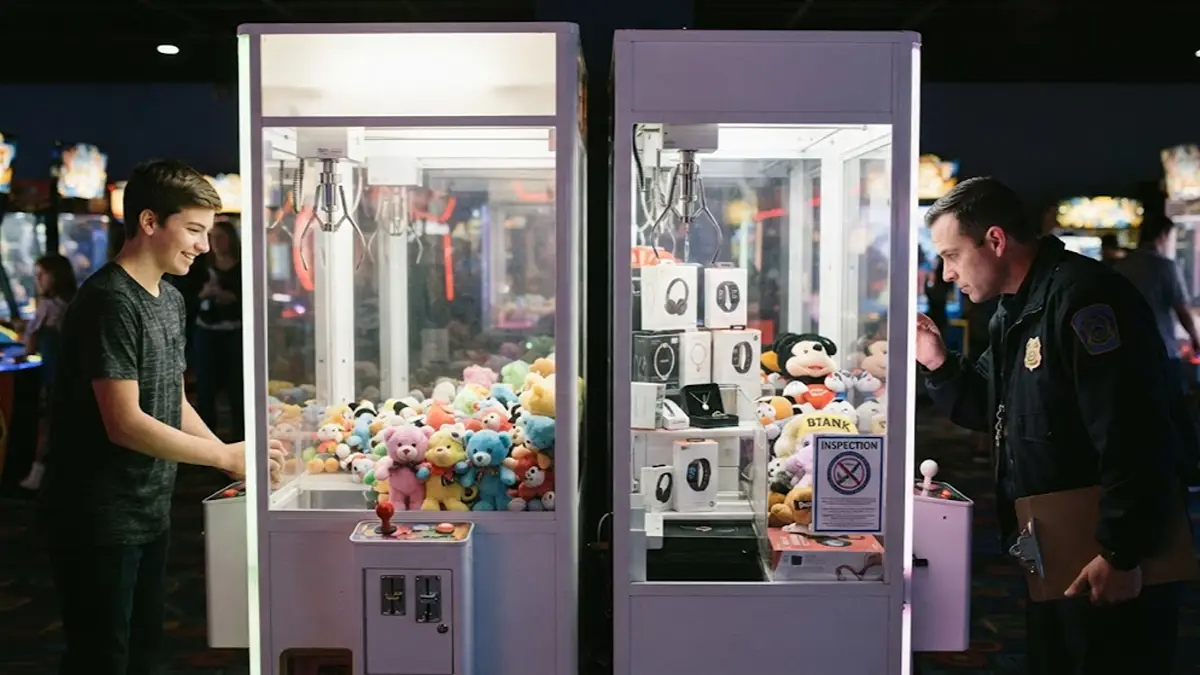
A claw machine typically falls under gambling rules when randomized payout settings override player skill, or when prize values exceed local statutory caps.
Most trouble starts when operators install a “profit mode” that decides the win, then load prizes that are worth too much. The following patterns are the ones enforcement officers look for during routine inspections.
Programmed Win Rates and Compensators
A compensator is a built-in mechanism that dynamically adjusts claw pressure to hit a target margin. In practice it means the claw only grips firmly after the machine has collected a set number of coins or a revenue threshold. Regulators read this as the machine, not the player, controlling the outcome, which mirrors slot-machine logic and can strip away the amusement exemption. Keeping claw strength consistent across every play remains the safest path.
Prize Type and Value Thresholds
What sits in the prize chute matters as much as how the claw grabs. Sticking to low-value, non-cash novelties such as plush toys and small keychains supports amusement status. Loading high-end phones, consoles, or luxury goods invites scrutiny because these often exceed local value caps. Any system that lets players convert won tokens, billets, or vouchers back into cash is treated as a red flag in most regions.
How the prize is delivered also shapes risk. Machines that dispense the physical item directly into the return slot tend to read as clearer skill games than setups that print tickets the player later redeems. Where ticket or coupon redemption is permitted, many frameworks expect the prize to be claimed on the exact premises where the play happened, which keeps the transaction from turning into a de facto cash payout.
Operational Red Flags That Attract Scrutiny
- Guaranteed-win timers: Settings that only allow a successful grab after a fixed coin count.
- Missing decals: Deploying machines without the local coin-op or amusement certificate that a jurisdiction requires.
- Misleading signage: Signs implying a machine is “due for a win” or advertising high-value jackpots, which can trigger deceptive-trade audits.
The specific line varies by market. In the United Kingdom, Par exemple, the UK Gambling Commission governs how machines with an element of chance are classified and permits them only under specific conditions. Aux États-Unis, the split happens at state level, and in parts of Asia, separate amusement-with-prizes regimes apply. The comparison below shows how a compliant, skill-based setup differs from one that draws gambling classification.
| Factor | Amusement Device (Compliant) | Gambling Risk (Non-Compliant) |
|---|---|---|
| Outcome driver | Player coordination, timing, and placement decide the win. | Programmed odds or a compensator decide the win. |
| Grip strength | Consistent on every single play. | Weakens or strengthens to hit a target payout rate. |
| Prize value | Low-value novelty, within local caps. | High-ticket goods above local caps, or cash equivalents. |
| Redemption | Physical prize dispensed or redeemed on premises. | Tokens or tickets exchanged back for cash or credit. |

Prize Value Caps: Illustrative Ranges by Jurisdiction
Amusement exemptions usually depend on keeping each prize under a local wholesale or retail value cap; these caps differ widely and change over time, so verify the current figure for your area.
The reward itself can trigger gambling laws even when the mechanics are fair. Many regions set a maximum value per prize, sometimes expressed as a flat wholesale cap and sometimes as a multiple of the cost of one play. The examples below are common reference points reported across various jurisdictions, not legal advice; confirm the live numbers with your local authority before you stock a machine.
| Jurisdiction (example) | Commonly Cited Prize Limit | Compliance Standard |
|---|---|---|
| Parts of the US (e.g. Alabama) | Often cited around $5 wholesale per play. | Player controls claw timing and duration. |
| Parts of the US (e.g. Ohio) | Frequently reported near $10 wholesale. | Treated as a skill-based amusement machine. |
| Parts of the US (e.g. Florida) | Often framed as a multiple of play value. | Direct merchandise dispensing, no cash. |
| United Kingdom | Category D limits apply per the Gambling Commission. | Chance-based machines need specific permits. |
Beyond the caps, two rules recur across most markets. First, cash and cash equivalents such as gift cards or redeemable vouchers remove the exemption almost everywhere. Second, prize buyback, where the operator exchanges won items back for money, is widely prohibited. For guidance on choosing compliant prize stock within these value bands, see our claw machine prize mix guide.
How Major Markets Frame the Rules
The same machine can be lawful amusement in one territory and a regulated gaming device next door, because each market draws the skill-versus-chance line differently.
Compliance is a patchwork. The summary below shows the general posture of the markets most operators ask about, but it is a starting point for your own verification, not a substitute for reading the current statute that governs your route.
United States
Aux États-Unis, the split happens at state and even municipal level. Many states exempt crane games from general gambling statutes when they award low-value novelties and hold consistent mechanical settings, but a stricter minority apply tighter definitions. Some states lean on play-time or grip-consistency standards to prove skill, while a few have treated certain chance-driven configurations as gambling devices outright. If you run a multi-state route, expect to research each jurisdiction rather than assume one rule fits all.
United Kingdom
In the United Kingdom, machines are grouped by category, and those where chance plays a role can fall under the Category D gaming framework overseen by the regulator. That route brings prize and stake limits, and it can require the premises to hold the right permission. A genuinely skill-forward setup is treated very differently from one driven by a compensator, which is why UK operators pay close attention to how the claw actually behaves in play.
Asia-Pacific and Other Markets
Across parts of Asia-Pacific and continental Europe, separate amusement-with-prizes regimes often apply. Some jurisdictions classify games that mix chance and skill under a dedicated licensing track, while others confirm that a basic pay-to-play machine with non-cash prizes sits outside traditional entertainment licensing. Because these frameworks change, operators placing machines in these markets should confirm the local licence type before shipping hardware.
Licensing, Permits, and Location Requirements
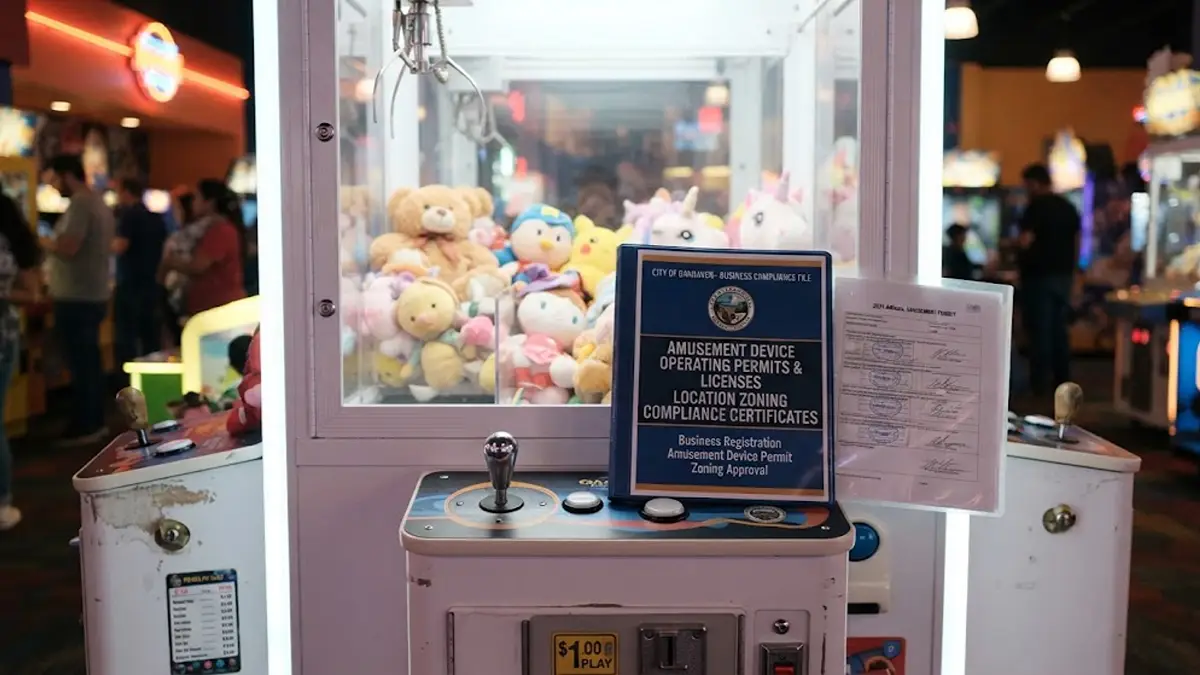
Commercial claw machine routes typically require business registration, an amusement or coin-operated device permit, and placement that satisfies local zoning codes.
Fair mechanics alone do not make an operation legal. You still need the paperwork, and you need to place the machine where the venue is allowed to run it. Requirements vary by municipality, so the items below are a common checklist rather than a universal list.
Core Business and Device Licensing
- Business entity: Register an LLC or corporation to define ownership and limit personal liability.
- Tax and sales permits: Secure the local operating certificates and sales tax permits your area requires to collect and remit revenue.
- Amusement or coin-op decals: Many jurisdictions require a per-machine permit, an annual renewal fee, and a visible registration tag on each cabinet.
- Insurance: General liability cover is commonly expected by venues and municipalities.
Zoning and Venue Placement
- Zoning check: Confirm the target retail or commercial district permits coin-operated amusement devices.
- Venue permits: Verify the host location holds the premises-level permits needed to run commercial machines.
- Proximity buffers: Some regions restrict amusement venues near schools or places of worship; check the local distance rules.
- Placement agreements: Use written revenue-share contracts with hosts that define utilities, entretien, and liability.
What Happens When Compliance Fails
The consequences of getting classification or paperwork wrong scale with how far the setup drifted from amusement rules. In most markets the first impacts are administrative: machines seized on the spot, fines, and revoked or denied permits that stop the route. Where a regulator concludes the device was an unlicensed gambling machine running a prize-redemption scheme, the exposure can grow into criminal liability and civil claims under deceptive-trade or consumer-protection law. The cheapest safeguard is documentation: keep grip-test records, prize invoices, and current permits so you can show a good-faith, skill-based setup the moment an officer asks.
Pre-Installation Compliance Checklist
Before a machine goes on site, run this sequence. It moves from setting the legal baseline, to locking the configuration, to verifying it after placement, which mirrors how regulators actually audit an operation.
| Étape | What to Lock Down | Pourquoi c'est important |
|---|---|---|
| 1. Confirm classification | How your state or country classifies claw machines (skill vs chance). | Determines which permit path and prize rules apply. |
| 2. Set the mechanics | Disable compensators and random win-rate logic; fix grip strength. | Keeps skill as the dominant factor and protects the exemption. |
| 3. Cap the prizes | Non-cash novelty stock under the verified local value cap. | High-value or cash-equivalent prizes trigger gambling rules. |
| 4. Obtain permits | Business, tax, and amusement-device decals for each cabinet. | Missing permits invite fines and seizure on the spot. |
| 5. Verify the venue | Zoning status, host premises permit, and any school buffer. | A legal machine in an illegal location is still a violation. |
| 6. Keep records | Grip-test logs, prize invoices, and permit expiry dates. | Documentation is your primary shield during an audit. |
Foire aux questions
Are claw machines legal in the United States?
Généralement oui, but legality depends on state and local law. Regulators look at whether the machine is a game of skill or chance. To keep amusement status, operators configure machines so skill stays the primary factor and limit prizes to non-cash merchandise under the local value cap. Some states have explicit rules for these devices, while others can treat chance-based or auto-percentaging machines as gambling.
Do you need a license to run a claw machine?
Commercial operators usually do, while private home use generally does not. A typical commercial setup needs a local business license, state sales tax registration, and an amusement or coin-operated device permit for each machine, often with an annual fee and a visible decal. Requirements differ by municipality, so confirm the exact permits with your local licensing office.
What is the difference between a skill setup and a chance setup?
A skill-based machine gives consistent grip on every play, so timing and spatial judgment decide the result. A chance-based machine uses software to vary grip so a win only happens after a target number of plays or a revenue threshold. When programmed odds override physical skill, regulators are far more likely to reclassify the device as a regulated or illegal gambling machine.
What prize value makes a claw machine illegal?
There is no single global number. Many jurisdictions cap the value of each prize, sometimes as a flat wholesale limit and sometimes as a multiple of the play price, and cash or cash-equivalent prizes are usually banned outright. Because these caps vary and change, verify the current local limit before stocking a machine rather than relying on a figure quoted online.
Pensées finales
Claw machine legality is decided by configuration and paperwork, not by the machine’s name. Consistent grip that keeps skill dominant, low-value non-cash prizes under your local cap, and the correct permits for both you and the venue are what separate a running route from a seizure notice. Because the specific thresholds vary so much, always confirm the current rules with your local authority before you install.
For operators sourcing a compliant fleet: confirm how your area classifies claw machines, request machine specifications and any playability documentation, approve a sample unit, then lock the grip and prize configuration before placing a bulk order. TKY’s skill-based cabinets are built to consistent grip strength and support OEM configuration to match local codes. Contact TKY to spec machines for your market and verify technical playability before your next installation.