A cut string game cabinet and a claw machine pull on two different player instincts and earn on two different clocks. One sells a single high-tension attempt at an expensive prize hanging behind glass. The other sells dozens of cheap plays to whoever walks past. Choosing between them is a floor-yield decision, not a matter of taste.
This comparison runs the two formats through the four things that decide revenue: mechanics, पुरस्कार अर्थशास्त्र, payout configuration, and the load each cabinet puts on your staff. It closes on where a mixed deployment beats picking a side.
What Is a Cut String Game?

A cut string game is an arcade cabinet in which the player positions a motorized blade and releases it to sever the cord holding a suspended prize. A clean cut drops the prize into the retrieval bin below.
The draw starts with what players see before they spend anything: a high-value item dangling from a single thread. One cutting motion carries the whole challenge, which is why these cabinets read as skill tests from across the room and stop foot traffic that a claw well does not.
The Cutting Mechanic
TKY builds its scissor-cutter layout around one control. The player holds the button to drive the scissors forward along the cord, then releases it at the chosen moment to close the blades. The door opens on a successful cut and the player collects the prize. Holding one button for both travel and timing keeps the attempt legible to a first-time player.
A 180-degree transparent cabinet body and a rear mirror let players judge blade position from more than one angle. That matters because the front glass rarely lines up exactly with the cutter’s physical path, and a player who can see the offset plays longer.
Prize Load Out
Every prize hangs on its own cord instead of piling in a well. That one structural change drives the rest of the format. Fewer units sit in the cabinet, value per unit rises, and the aisle gets a single clear focal point.
Hanging also sets a size ceiling in the player’s favor. Standard three-prong claws get unreliable past roughly 12 inches of plush, और यह claw machine plush size guide TKY published puts anything larger into jumbo or cut string mechanics. The cutter is where the prizes too big for a claw finally become sellable.
Where The Format Earns
TKY’s own specification sheets list the venues these cabinets ship into: arcade halls, पारिवारिक मनोरंजन केंद्र, game centers, malls, सुपरमार्केट, सिनेमाघरों, and hotel lobbies. The common thread is foot traffic with dwell time, because the format needs onlookers as much as players.
A cutting cabinet in a corridor nobody stops in earns a fraction of the same unit placed where players gather to watch one attempt. Budget for the sightline before you budget for the prize.
कट स्ट्रिंग गेम बनाम क्लॉ मशीन
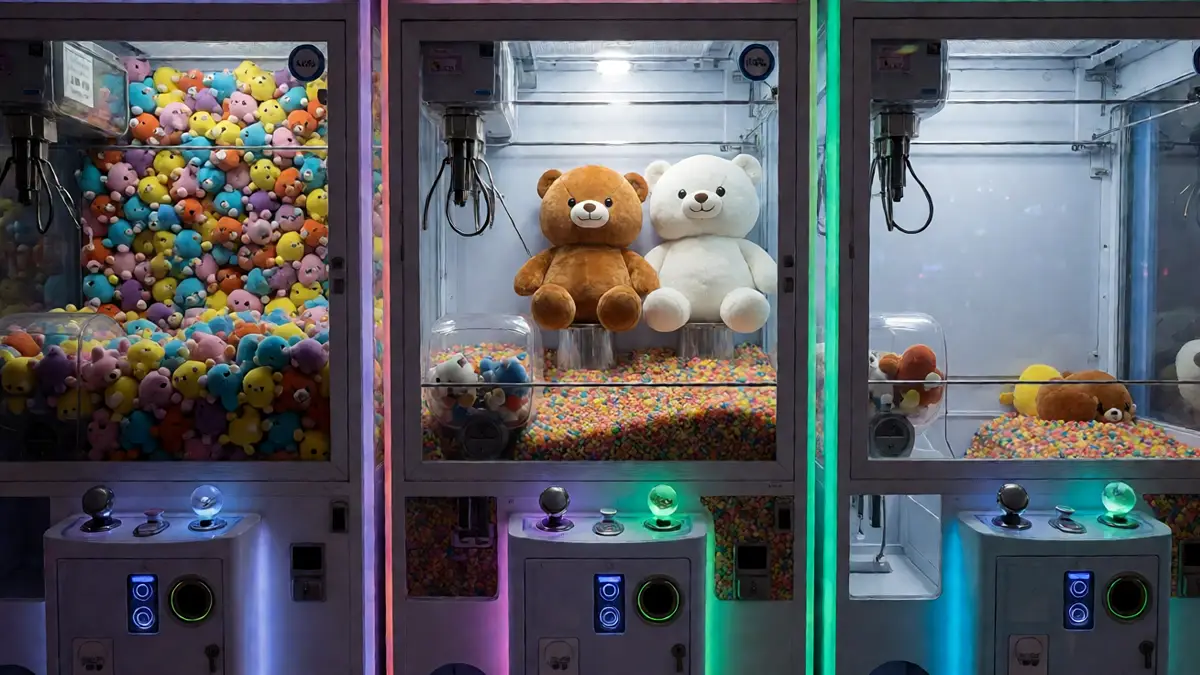
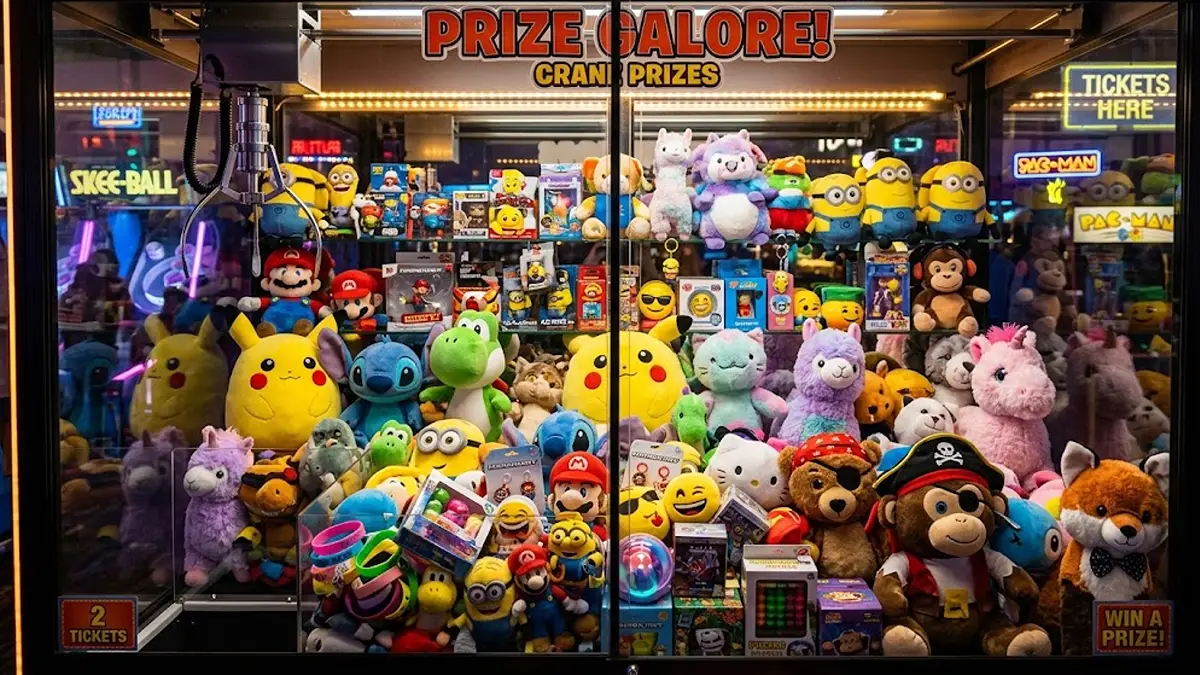
Claw machines earn from many low-cost plays, while cut string cabinets earn from fewer, higher-priced attempts. Most profitable floors run both, because the two revenue patterns cover each other’s weak spots.
Operators comparing a cut string game against a claw machine are usually fighting for the same floor space. The claw keeps the lights on with steady family plays. The cutter acts as a visual anchor that converts onlookers into competitive players.
| Feature | Cut String Game | Claw Machine |
|---|---|---|
| Prize Type | Individually hung premium stock: इलेक्ट्रानिक्स, jumbo plush | Bulk low-to-mid value plush, capsules, कैंडी |
| Revenue Pattern | High-priced attempts, wins spaced over many plays | Consistent micro-plays from families and teens |
| Payout Control | Blade travel and cutting force gated by win-rate setting | Grip strength phases, counter or turnover thresholds |
| Service Load | Hand-tie and tension each cord, secure premium stock | Bulk refill in minutes, standardized wear parts |
Stakes Per Attempt
A player at a cutting cabinet commits to one precision act with a narrow margin of error. At a claw machine, the same player tests a grip that varies from pickup to drop, against a pile of lower-cost prizes. The first feels like a duel; the second feels like a lottery with a joystick, and players accept much lower stakes for it.
That perception gap sets your pricing. Premium hanging stock supports play prices at the top of the range; bulk plush in a well does not.
Economics Per Play
TKY’s claw machine prize mix guide prices premium merchandise at $2.00 को $5.00 per play against prizes costing $8.00 को $20.00 wholesale, with tighter win thresholds. That is the band a hanging electronics or jumbo plush prize belongs in.
Claw cabinets work the other way. The same guidance keeps total prize cost inside 25% को 35% of gross revenue across tiers, which a $1.00 play only clears on high volume. Cut string cabinets reach the same margin on fewer wins and larger cash spikes instead of a steady drip.
Boost Profits with Premium Barber Cut Games

Payout Control and Player Trust
Payout configuration decides whether a cutting cabinet is a skill machine or a machine players describe as fixed. Operators set it, and regulators look for exactly it.
Two setups exist in the field. A deterministic setup cuts whenever alignment and timing are correct, so a perfect attempt always wins. A gated setup restricts blade force or offsets motor travel until the cabinet has collected a target amount, then opens a true-skill window.
Adjustable win rate is a published specification on the cut string arcade games TKY builds, alongside a self-developed mainboard that trims the cutting path in 0.1 mm micro-steps. Both are operator settings rather than player-visible handicaps. That is why how players read the cabinet matters more than the spec sheet.
Two Levers Operators Turn
Payout tuning works on two physical settings as well as the software target. Blade overlap sets how much clearance the closing scissors leave around the cord, which defines the window a player has to hit. Motor travel speed sets how long that window stays open.
Tighten both and the cabinet pays out less often while still reading as fair from the aisle. Loosen them and wins arrive faster. Every operator makes that trade again for each venue, because a mall corridor and a dedicated arcade floor do not tolerate the same dry spell.
Where Gating Becomes A Legal Problem
Gating that overrides player skill moves a cabinet from amusement toward chance, and that is the line regulators police. Under the UK Gambling Commission’s family entertainment centre rules, an operator who makes category D gaming machines available in an arcade needs a permit from the local licensing authority. An operating licence from the Commission is not required for that setup.
The same guidance adds a second line: no licence is needed where a machine offers no prize, or where the prize is worth no more than the price of play. US treatment varies state by state, so one compliance answer does not travel across a route. TKY’s breakdown of whether claw machines are legal walks through that market-by-market logic, and the same tests apply to cutting cabinets.
How Experienced Players Read A Cabinet
Players who spend real money on cutters inspect before they insert credits. They look for cords already showing wear, prizes hung close to the chute so a fall does not snag, and heavier stock that holds the line taut and steady.
Operators running tight gating should expect that behavior and its consequence. A player who reads the cabinet correctly stops after a handful of accurate attempts that fail. That player then carries the verdict to every other cabinet in your venue. Trust is the asset a cut string game sells, and a heavy gate burns it first.
Floor Planning and Installation Needs
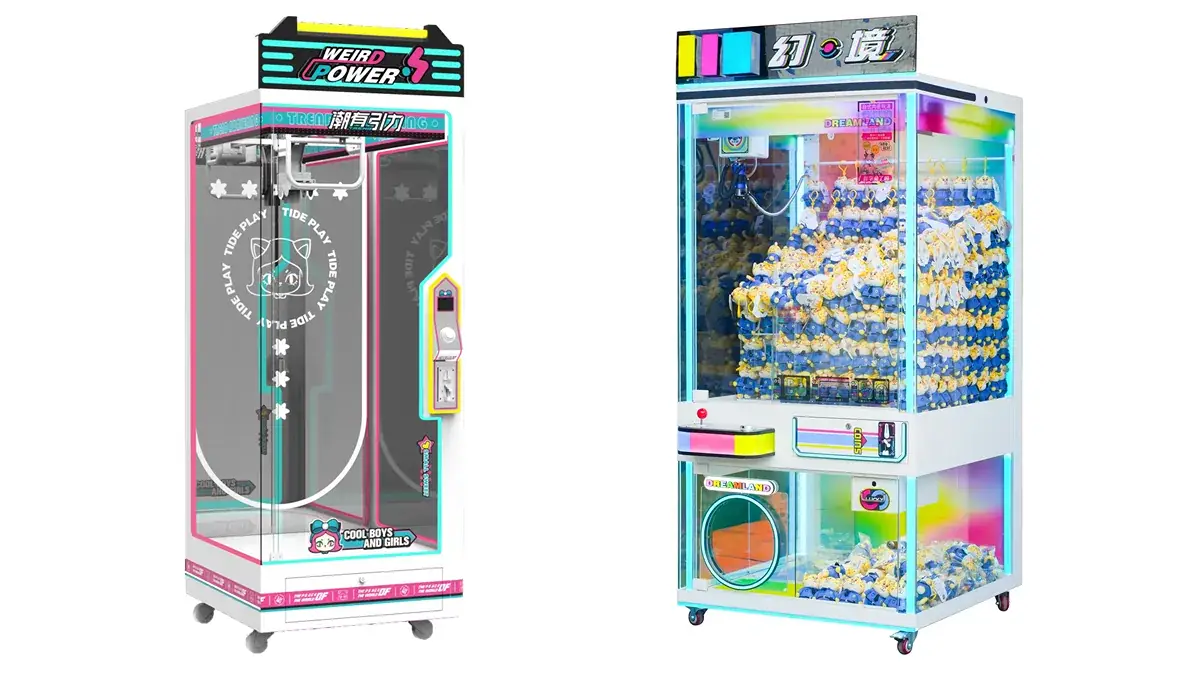
Cutting cabinets are taller, heavier, and slower to restock than claw machines. Confirm the delivery envelope and the service clearance before the unit ships, not on delivery day.
Matching the physical format to your space is the difference between a marquee anchor and a machine that sits behind a pillar. TKY’s scissor-cutter specification sheet shows the envelope you are planning around.
- Scissor-cutter cabinet: 800 × 850 × 2,018 मिमी, 150.5 किग्रा, 250 W rated power.
- Height is the constraint: measure the doorway, lift, and corridor on the delivery route before ordering, because these cabinets cannot be tilted to clear a low header.
- Service clearance: blade alignment, cord replacement, and prize rotation all happen with a panel open, so leave working space behind and beside the unit.
Electrical load is rarely the problem. Rated draw on that unit is 250 डब्ल्यू, well inside what an arcade circuit already carries. Confirm plug type and voltage for the destination market with the factory before shipping, and route cables through floor covers along any pedestrian path.
Restocking is the real labor difference between the formats. A claw well takes minutes to refill in bulk. A cutting cabinet needs each cord tied, tensioned, and positioned by hand, and premium stock wants a manager present during the swap. TKY’s guide to maintaining arcade machines credits a scheduled check routine with cutting machine downtime by up to 20%. On a cabinet holding a hanging electronics prize, downtime is the cost you feel first.
Combining Cut String Games With Claw Machines
A mixed floor assigns each mechanic a different job: the cutter anchors attention and monetizes the risk-tolerant player, while claw rows absorb throughput from everyone else.
The most profitable layouts do not choose a side. They run a calculated mix, because floor space in a family entertainment center is too expensive for a single-purpose machine that only earns on jackpot days.
- Entry anchor: one large cutting cabinet near the entrance to capture impulse play and set the venue’s prize ceiling.
- Throughput cluster: claw machines in rows or islands behind it, handling bulk player volume at $1.00 plays.
- Fallback path: a claw bay within sight of the cutter, so a failed premium attempt converts into a same-visit play instead of a walkout.
Sightlines Beat Signage
The cutting mechanic only reads as skill when players can watch the blade meet the cord. Interior spotlights and high-transparency glass exist to make that moment visible from the aisle, and a cabinet in a low-visibility corner loses most of the format’s advantage. Give the machine a multi-angle sightline rather than a straight-on one.
Tiering The Prize Offer
Split value across the two mechanics instead of duplicating it. Hang the aspirational items on cords and keep fast-moving filler in claw wells, then let the win frequency of the claws fund the patience the cutters demand.
Price the tiers apart as well. A $2.00 को $5.00 cutting attempt next to a $1.00 claw play gives one visitor two entry points. It also keeps the premium cabinet from cannibalizing the volume that pays your rent.
Staffing The Restock
Decide who ties the cords before the machine arrives. Restock work on a cutting cabinet is slow by nature: attach, tension, position, then check that the hanging line clears the blade path. A multi-cord unit takes longer than a claw well, and it takes someone you trust near premium stock.
Write that job into the service schedule you already run on the claws. Prize rotation keeps the display fresh for returning players, and a cabinet that still has last season’s hero item hanging in it tells regulars the floor has stopped changing.
अक्सर पूछे जाने वाले प्रश्नों
What is a cut string game?
A cut string game is an arcade cabinet where the player aligns a motorized blade and releases it to sever the cord holding a suspended prize. A clean cut drops the prize into the bin below. Winning depends on positioning and timing rather than on a claw’s grip strength.
Is a cut string game skill or chance?
Both answers exist, because the operator picks the configuration. A deterministic setup lets a perfect attempt win every time. A gated setup limits blade force or travel until the cabinet reaches a revenue target, then opens a true-skill window. That second mode is what draws regulatory scrutiny.
Which earns more, a cutter or a claw?
Neither wins outright. Cut string cabinets charge more per attempt, commonly $2.00 को $5.00, but pay out far less often. Claw machines earn on high play counts at $1.00. A floor with both earns more, because the two cover different parts of the same visit.
Can these cabinets hold expensive prizes?
हाँ. TKY builds these units with tempered glass, anti-shake sensing, and interior spotlights to display high-value stock such as electronics and jumbo plush. Wholesale orders include a starter set of blades and replacement cords, and spare parts stay in stock.
What prizes hang best in these cabinets?
Oversized and soft, mostly. Jumbo plush past the 12-inch limit a claw can handle is the standard choice, along with boxed electronics and branded merchandise. Each item needs a secure attachment point that will not slip under constant tension. Mix one hero prize with two or three mid-tier cords.
अंतिम विचार
Judge a cut string cabinet on three things before it ships. Check that the payout configuration matches the law where the machine will stand. Check that your crew has time to tie and tension cords on every restock, and that the floor can give up the height and clearance the cabinet needs. Those three answers decide the format’s profitability more than whatever prize hangs inside.
The specification side is the easy part to verify. Ask for the dimension sheet, the rated wattage, and the win-rate menu for the exact model you plan to buy, then check them against your delivery route. Our team can walk through cabinet selection and mixed-floor layouts for your venue.