Sourcing plush that does not match your claw hardware shows up fast: dropped prizes, jammed chutes, and thin route margins. When toy dimensions and the gantry are out of sync, the machine plays poorly and players stop feeding coins into the slot.
This guide benchmarks claw machine plush size against common arcade practice — claw-to-width ratios, весовые группы, and cabinet fit — to help you set a more predictable payout. The figures below are typical industry benchmarks rather than fixed rules, so confirm them against your own machine specifications and venue.
One note on measurement: plush is normally sized by its longest upright dimension, and a stuffed toy compresses, so the same model can read differently once squeezed. When you compare a supplier sample to your claw, measure the body width at its widest point and weigh the toy unstuffed of any hang tags, then test a physical sample in the machine rather than trusting the listing alone.
Why Plush Size Matters in Claw Machines
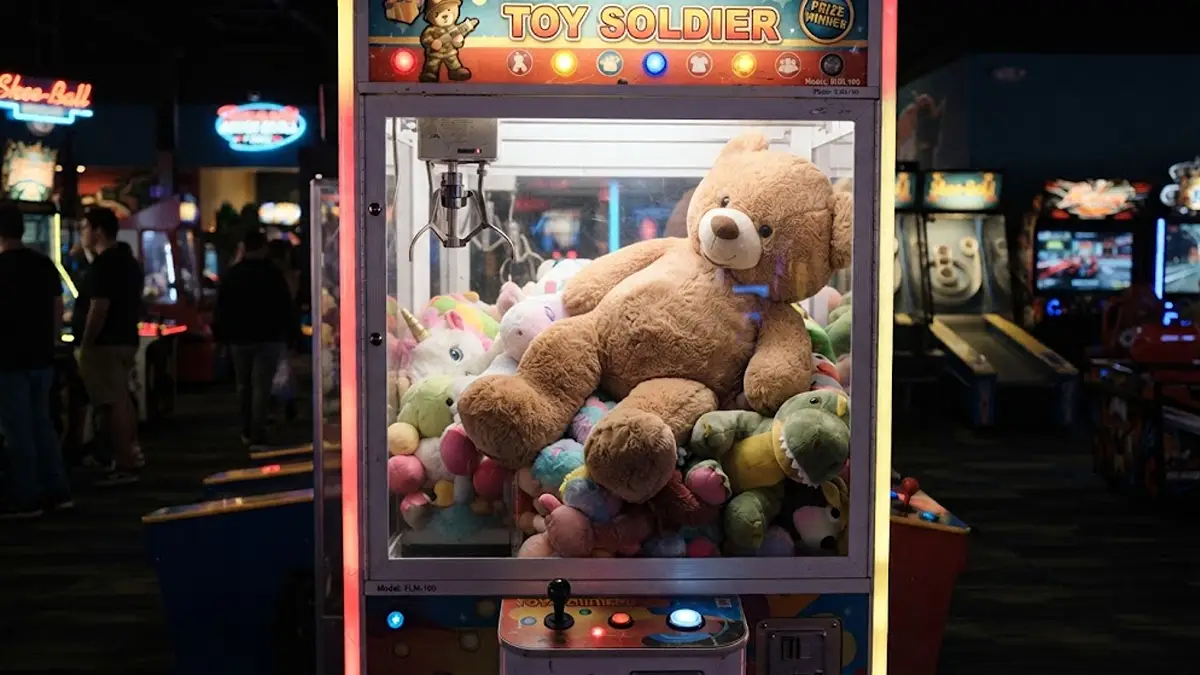
Matching plush size to claw mechanics and venue economics supports steadier win rates, reduces mechanical jams, and protects route margins.
Understanding why plush size matters is the first step to resolving high drop rates. If your toys do not fit the hardware, no amount of claw-strength tuning makes the game play fairly.
Mechanical Fit and Claw Closure
Operators often overlook the physical match between the toy and the metal prongs. A mismatched setup leaves the claw closing on empty air or slipping off the body.
- Claw closure: Choose plush dimensions that let the claw close fully or nearly fully around the toy body.
- Sizing ratio: A common rule of thumb is a plush body width around 1.5 times the claw’s open span, so the prongs wrap the midsection rather than pinch fabric.
- Grip obstacles: Oversized prizes make claws slip; undersized items fall through wide-spaced fingers.
Win Rate and Payout Economics
Toy dimensions act as a physical regulator on payout. Adjusting prize size changes both the unit cost and the perceived difficulty of the game.
- Target win rates: Many operators balance plush size with wholesale unit cost to sit within a 10% к 30% win-rate band.
- Cost-to-play ratio: A common benchmark keeps prize cost near 20% к 30% of the play price for sustained profitability.
- Play price scale: Small and medium plush typically suit around $1 plays, while jumbo showcase prizes support roughly $2 к $5.
Size also scales with weight and material. Heavy plush strains standard coils, while slick or overstuffed fabrics escape the grasp, and a cabinet that looks empty or cheap suppresses foot traffic regardless of how fair the settings are. For how prize value and filler ratios drive margin, see our claw machine prize mix guide.
Visual Merchandising and Player Psychology
Beyond the mechanics, how a cabinet looks decides whether players stop at all. A sparse or cheap-looking bed suppresses foot traffic even when the payout settings are fair, so plush size doubles as a merchandising lever.
- Standard anchors: Medium plush around 7 к 12 inches is often used to deliver strong perceived value at an accessible price point.
- Jumbo draws: Larger 18 to 30-inch pieces act as high-visibility anchors that pull foot traffic from across the venue.
- Fill density: Sizing prizes appropriately keeps the cabinet looking full, colorful, and active rather than picked-over.
Blending smaller volume fillers with a few high-value anchor items creates a layered display that supports impulse play without pushing average prize cost out of your target band.
Common Plush Sizes for Claw Machines
Fitting common plush size bands to your claw span and cabinet depth helps prevent chute jams and stabilizes your payout rate.
Operators categorize inventory into height bands. Each class drives the visual volume and grab mechanics of the playfield, as summarized below.
| Size Class | Typical Height | Common Weight | Best Use |
|---|---|---|---|
| Мини | 2 к 4 в | 10 к 25 g | Countertop units and prize capsules |
| Маленький | 4 к 8 в | 45 к 65 g | High-turnover route filler |
| Medium | 7 к 11 в | 150 к 220 g | Primary volume class for arcade cranes |
| Jumbo | 10 к 15 в | Varies | High-value visual anchor prizes |
| Giant | 16 к 36+ в | Varies | Cut-string and showcase cabinets |
Mismatching these bands with the physical cabinet limits payout predictability and creates mechanical errors. Full-sized floor cranes tend to run most reliably in a 7 to 10-inch sweet spot, mini and countertop setups require compact 2 to 7-inch plush, and specialty cut-string or jumbo showcase machines rely on larger 12 to 20-inch-plus prizes.
Merchandising Density and Case Buys
How you distribute these classes across one cabinet matters as much as the classes themselves. Most profitable beds combine three stocking roles rather than a single size.
- High-density fillers: Small items bought in bulk cases (often 100-plus pieces) build visual volume cheaply and drive frequent wins.
- Medium anchors: Стандартный 8 to 10-inch plush sits in the center of the playfield as the primary perceived-value driver.
- Low-density highlights: A few jumbo showcase prizes act as rare, aspirational targets that encourage premium-tier attempts.
Holding this tiered structure lets you keep the machine appealing while the fillers carry most of the play volume and the highlights stay rare enough to protect margin.

How Size, Масса, и форма влияют на игровой процесс
Balancing claw machine plush size, масса, and shape supports stable win rates and helps prevent expensive chute blockages.
A claw wrap that matches on paper can still fail on the floor if weight and geometry are ignored. These physical traits decide whether a clean grab turns into an actual win.
Weight Thresholds and Lift Stability
Weight calibration dictates whether the claw can complete a lift. If prize weight is out of sync with your coil settings, the machine fails to execute a clean grab.
- Mini band: Compact countertop machines typically suit 10 к 25 g prizes to protect weaker coils.
- Standard arcade band: Full-sized commercial cranes commonly run 150 к 220 g for predictable lift behavior.
- Overweight risks: Heavy items cause slippage, motor stalls, or immediate drops on retraction.
- Underweight risks: Ultra-light items fail to settle in the claw and can be shifted by gantry movement.
Shape and Surface Grip
Claw fingers need friction and anchor points to hold during gantry travel, which is where geometry matters as much as size.
- Grip protrusions: Ears, limbs, tails, and heavy seams give the prongs natural purchase points.
- Compressible stuffing: Soft-to-medium stuffing deforms slightly under pressure, increasing claw contact.
- Anti-slip shapes: Perfectly round or smooth prizes tend to slide off unless the machine uses a scoop claw.
Physical Synergy and Machine Alignment
Profitable operators do not weigh these traits in isolation. Size, масса, and shape are tuned together to produce a fair, repeatable grab that still lands inside the payout target.
- Optimal synergy: Moderate size, balanced weight, and an irregular or textured body tend to produce the most stable, playable setup.
- Specialized formats: Cut-to-win or heavy-duty cranes are usually reserved for giant or awkward inventory standard claws cannot lift.
- Core mix: Building the main inventory around textured, medium plush supports consistent win rates across a route.
How to Match Plush Size With Claw and Cabinet Dimensions
Applying consistent ratios to match plush size with claw and cabinet dimensions protects payout margins and reduces mechanical jams.
Operators who want steady route revenue must match plush size to both the claw span and the cabinet. Incorrect setups drive drop rates, mechanical damage, and player frustration. Use the cabinet bands below as a starting point, then confirm against your hardware.
| Cabinet Type | Typical Width | Playfield Pattern | Recommended Plush Band |
|---|---|---|---|
| Мини / Countertop | 18 к 24 в | Shallow bed, small claw | Mini to Small (2 к 7 в) |
| Standard Route / Arcade Crane | 24 к 32 в | General-purpose, single-player | Medium (7 к 11 в) |
| Большой / Jumbo Cabinet | 36 к 48 в | Anchor machine, higher price point | Jumbo (10 к 15 в) + Giant (16 к 24 в) |
| Giant Claw / Cut-String | 40 к 48+ в | Showcase, one prize per bay | Giant (16 к 36+ в) |
Applying the Width-to-Claw and Well-Height Rules
These geometric ratios prevent empty playfields and mechanical faults where the claw carriage and the prize bed interfere.
- Width-to-claw span: Keep plush body width around 1.5 times the fully open claw span so prongs wrap the midsection instead of slipping off.
- Well height limit: Many operators keep target plush height under roughly 40% к 50% of the visible prize well so multi-layer stacking does not hit the carriage.
- Chute clearance: Ensure the largest plush dimension clears the exit drop area to avoid structural blockages.
Density, Масса, and Claw Strength Calibration
Weight and material density must align with claw settings, or the gantry slips on otherwise well-sized toys.
- Weight sweet spot: Стандартный 7 to 10-inch prizes often perform best near 150 к 220 g, a range many operators tune for predictable win rates.
- Grip tension: Adjusting claw strength within a moderate band manages lift-and-drop dynamics across small versus medium plush.
- Bed depth: A loosely layered bed lets prongs reach under toys; avoid packing the cabinet so tight the claw cannot penetrate.
Sourcing to Standardized Size Classes
Once your ratios are set, buy to a fixed set of size classes rather than one-off dimensions. Sourcing from standardized bands means you can move inventory between routes and cabinets without rebuilding the whole prize bed or re-tuning claw strength every time. When you order in volume, ask your supplier to state dimensions and weight as tolerances (for example a 7 to 10-inch, 150 к 220 g medium band) instead of a single number, so a normal production variance does not quietly push a batch out of your claw’s grip range.
Choosing Plush Sizes for Different Venues
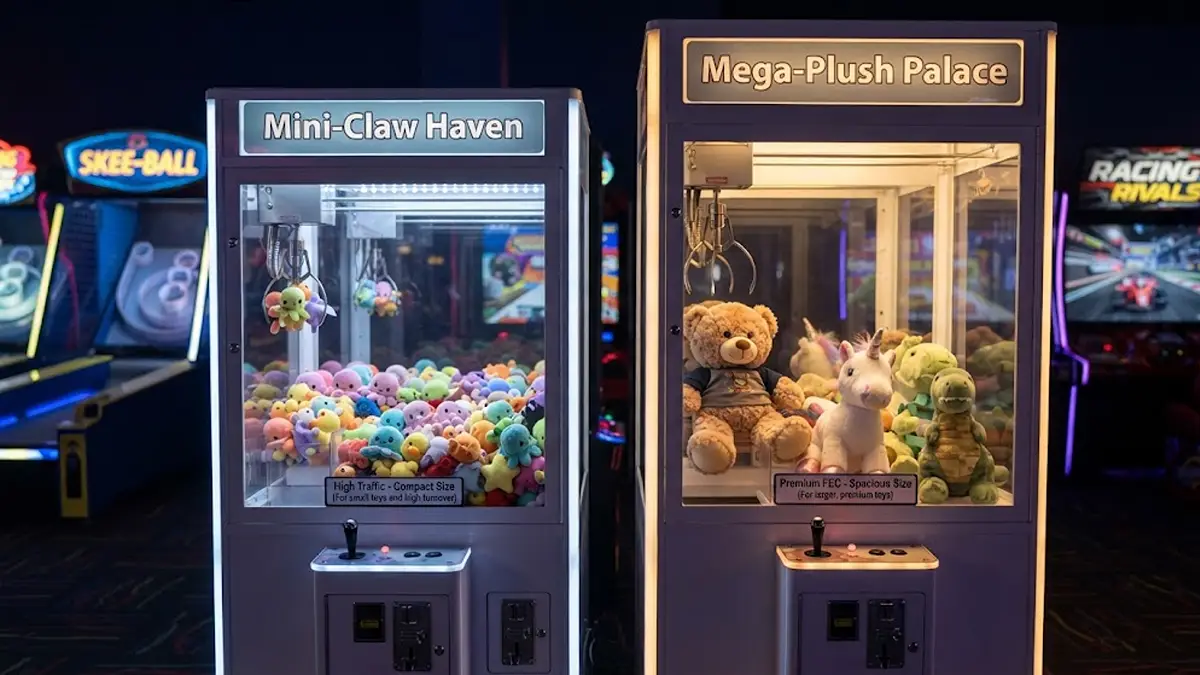
Matching plush dimensions to your location and claw mechanics supports predictable payout rates and reduces physical jams.
Selecting the right sizes per venue determines whether your cabinets generate consistent income or become a maintenance headache. Venue choice is really a matching problem in three parts: the foot traffic and dwell time of the location, the play price it can support, and the claw and cabinet hardware you install there. Align those three and the size band follows; force a jumbo display into a low-counter spot, or a mini into a premium floor, and either the mechanics or the margins break. Before finalizing a prize configuration for a new route, confirm local classification and any playability rules, as covered in our guide to коммерческие машины с когтями.
Small-Scale Venues
Diners, laundromats, and grocery entryways rely on casual, high-turnover family play, so the prize configuration should reflect that demographic.
- Target sizes: Use 2 to 7-inch minis on countertops and 6 to 9-inch small plush near retail exits.
- Pricing alignment: Shorter sizes suit lower cost-per-play settings and allow more frequent wins.
- Grip geometry: Simple, rounded shapes with soft stuffing help the claw wrap cleanly.
High-Traffic Hubs
Malls, cinema lobbies, and arcade centers demand visual impact to compete with surrounding noise, and players here pay more per attempt.
- Standard inventory: Many operators core-stock a 7 to 10-inch range to match premium play pricing.
- Visual anchors: Place 11 to 12-inch items at the front to draw traffic without overloading the bed.
- Character selection: Detailed character and licensed-style plush appeals to teens and collectors.
Premium Tourist Spots
FECs and destination venues rely on emotional souvenir purchases, so merchandise acts as a marketing draw across the floor.
- Billboard prizes: Giant 12 to 20-inch-plus plush in cut-string or high-capacity cranes serve as visual billboards.
- Hardware requirements: Chutes and doors should be rated for larger, heavier prizes to prevent jamming.
- Payout structure: Pricing and payout frequency offset the higher unit cost while keeping the win memorable.
Sizing Mechanics and Sourcing Guidelines
Even a well-themed prize fails if its dimensions do not match the claw. A few sourcing rules keep pickups clean across every venue type.
- Claw ratio: Buy to the roughly 1.5-times claw-span body width so prongs wrap rather than graze.
- Weight match: Keep standard toy weight inside the band your coils are tuned for, and scale down for mini cabinets.
- Bed consistency: Avoid mixing extreme sizes, such as 3-inch minis with 10-inch plush, so small toys are not buried under larger ones.
Часто задаваемые вопросы
What size plush toys work best in standard claw machines?
Standard commercial three-prong cranes are commonly stocked with plush between 7 и 10 дюймов в высоту. This band is large enough to read as high value through the glass, yet compact enough for standard prongs to wrap and lift. Toys under about 5 inches tend to slip through the fingers, while those well over 11 inches are more likely to jam the chute or stall the claw.
What is the ideal weight for claw machine plush prizes?
For standard arcade cabinets, plush weighing roughly 150 к 220 grams tends to give the most predictable lift and win-rate calibration. Prizes in this band sit in the pile without shifting too easily, yet stay light enough for calibrated motors to lift. In smaller tabletop or mini machines, prize weight usually scales down to the 10 к 65 gram range to match weaker coils.
How do you match claw size to a plush toy?
A common rule is to keep the plush body width around 1.5 times the claw’s fully open span, so the prongs scoop and cradle the torso rather than pinch fabric. Set the claw so its open width is slightly larger than the widest part of the toy. Aperture and claw size should still be confirmed against your specific machine’s manufacturer documentation.
Can you put jumbo plush in a standard claw machine?
Standard cabinets generally cannot reliably handle plush much beyond 12 inches. Oversized prizes lack the grab geometry for regular claws, so prongs cannot close fully and slippage or chute jams follow. For prizes around 11 к 18 inches, operators typically move to dedicated jumbo machines, and giant plush usually needs cut-string or other specialized mechanics.
How many plush toys fit inside a standard claw machine?
A standard arcade crane often holds around 40 к 60 medium (7 to 10-inch) plush, and capacity rises when stocked with smaller items. The exact count depends on cabinet depth and toy bulk. When filling the bin, avoid packing too tightly; a slightly loose, multi-layered bed lets the prongs penetrate and grab.
Заключительные мысли
Дешевый, unrated toys may lower stocking costs on paper, but prizes built to consistent mechanical specifications are what protect route margins from high drop rates and recurring gantry jams. Matching your claw machine plush size to your hardware supports predictable win rates and keeps players engaged. Treat every figure here as a benchmark and validate it against your own machines.
For operators stocking a route: define your target win rate and machine types, request toy dimensions and weight tolerances in writing, approve a sample lot, then lock the size specification before placing a bulk order. The IAAPA resource hub offers broader venue benchmarks. TKY’s factory and R&Д team can customize grip and cabinet configuration to your prize sizes. Contact TKY to align machines with your plush lineup.